
The AGP bus system was launched by Intel in 1996 as the PCI bus has proven to be a bottleneck for the graphics card for the ever-increasing amount of data between processor, memory and graphics card. The AGP bus only allows the use of graphics cards, while the PCI bus is a universal bus that allows the use of different plug-in cards. Thus, the entire bandwidth can be used without having to take other devices into account.
The facilities on the motherboard consist of the AGP slot, and the AGP bridge, which is housed in the chipset’s Northbridge. The Accelerated Graphics Port Enables a point-to-point connection between graphics card and chipset. The graphics card is therefore connected to the CPU and memory in the fastest way. In order to also enable memory accesses past the CPU and thus provide for the discharge of the processor, the AGP is assigned a specific memory area in the RAM by the BIOS. This memory is called AGP-Aperture. The Accelerated Graphics port has a bus width of 32 bits and double the bus clock of 66 MHz compared to PCI.
Bodywork:
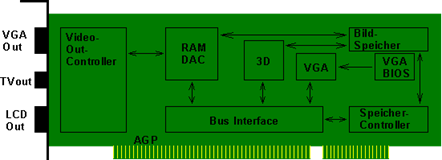
Due to the high volume of data between the graphics card and the processor, the graphics card is equipped with its own processor, which is specifically responsible for the calculation of graphic objects.
Also an important component is the RAM-DAC (Digital Audio Converter). It converts the digital information of the image memory into an analog signal which the monitor can display. The more MHz it has, the higher resolutions and color depths are possible.
Various image memories are available for the data sets.
For example:
DRAM is the cheapest and slowest type of memory used.
V-RAM It’s a very expensive type of storage. It is dualported, i.e. it is simultaneously written into the memory by the processor while the RAM-DAC reads out the memory.
W-RAM (Window-Ram) works like V-RAM, but is produced cheaper and has thus almost completely displaced V-RAM from the market.
The ports of a graphics card contain a VGA port for the screen port. The map may already have a new DVI port, which digitally sends the data to the screen, while the VGA port must first convert the data analogously.
Usually, a TV-out connection is also integrated, for example, to watch movies on the TV.
Various techniques are used: For example:
- Pipelining: Instead of starting a data request and waiting for it, pipelining immediately starts the next one after the first request, before the data is delivered. As a result, the waiting times are used more effectively, which increases performance.
- Sideband Addressing: Increases data throughput by passing commands through a separate parallel channel.
There are different modes with which different bandwidths are achieved.
Already in the AGP 1x mode At 266 MB/s, the AGP bus delivers twice the bandwidth of the PCI bus because the bus clock was doubled from 33 to 66 MHz. However, it is transmitted only with rising edge. The signal range is 3.3V.
Intact 2x mode On the other hand, rising and falling edges of the clock signal are used and thus also twice the transmission rate compared to the 1x mode is achieved, namely 532 Mbyte/s.
A bandwidth of 1.06 GB/s reaches the 4x mode with a signal range of 1.5 volts, since 4 data words are transmitted per clock.
8 data words per cycle 8x mode The AGP bus therefore has a transmission rate of 2.1 GB/s at 0.8 volt voltage.
The AGP slots are backward compatible, so older graphics cards can also operate in newer boards.
In the future, new motherboards should no longer have support for AGP, and instead use PCI Express.
PCI-Express is a serial bus and allows significantly higher data rates than the AGP bus.